[Overview of Results Collected During EUC Score Test Runs]
SxS RDP on Windows 365 - No GPU [2025]
 Test Engineer: Benny Tritsch
Date of test: 14-15 July 2025
Test Engineer: Benny Tritsch
Date of test: 14-15 July 2025
Test Goal
Show the performance impact that different network conditions have on a SxS RDP session connected to a Windows 365 VM with 8 vCPUs and no GPU. The reference on the left (yellow) side is always 100mbps bandwidth, 10ms latency, 0% packet loss. The network conditions on the right-hand side (red) are constrained by either an 8 Mbps bandwidth limit, a latency of 110 ms, or a packet loss rate of 2%.
The various network conditions are simulated using a physical WAN emulator located in the network connection between the endpoint device and the internet router. The latency (round trip time - RTT) between the test lab and the Azure data center in Frankfurt, Germany, is 10 ms.
Selected Sync Player Clips
| Simload Thumbnails | Links | Network | Links [Charts] | Views | Observations |
|---|---|---|
|
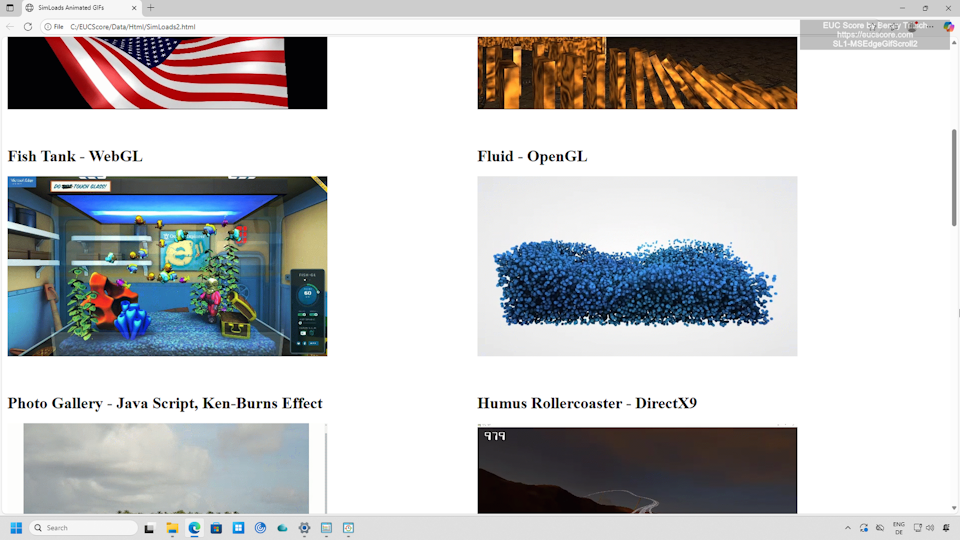
Bandwidth: 100mbps vs 8mbps
SL1-MSEdgeGifScroll2 [STD12] Side-by-Side View |
The animation shows significant stuttering and displays freeze frames on the right side (red). As expected, the network bandwidth usage is significantly lower. At the same time, reduced CPU load and fewer context switches per second can also be observed under low bandwidth conditions. |
|
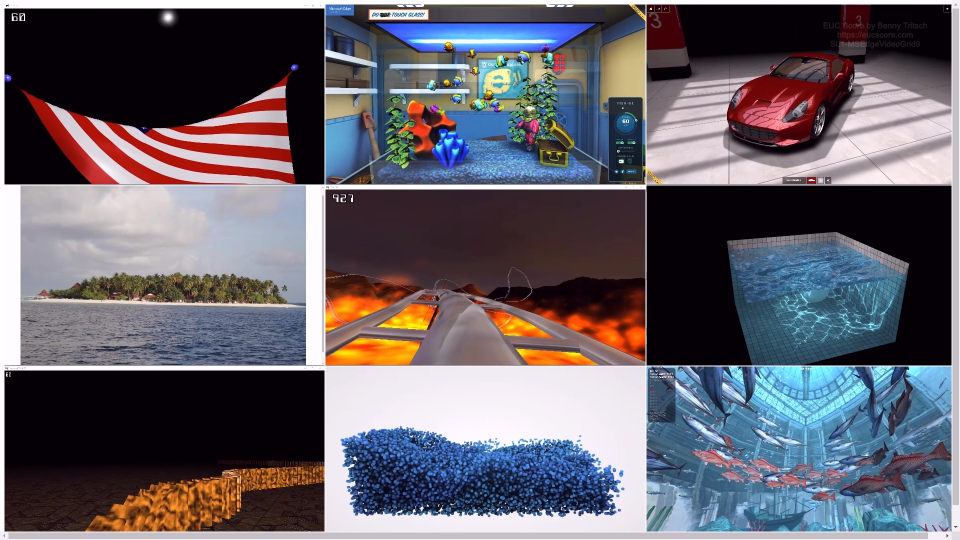
Bandwidth: 100mbps vs 8mbps
SL1-MSEdgeVideoGrid9 [STD12] Side-by-Side View |
Due to the significantly lower network bandwidth usage on the right side (red), the videos show a reduced frame rate and stuttering, while image quality also suffers due to compression artifacts. At the same time, the CPU load and context switches per second values are lower. |
|
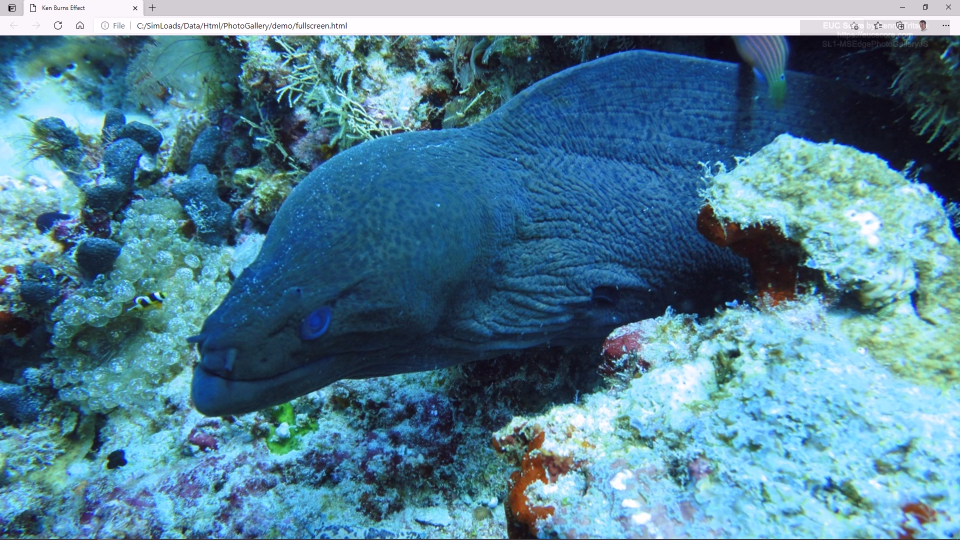
Latency (RTT): 10ms vs 110ms
SL1-MSEdgePhotoGalleryJS [STD12] Side-by-Side View |
There is virtually no discernible difference between the session without latency and the one with an additional 100ms of latency. The performance counters also show almost identical values. |
|
|
Latency (RTT): 10ms vs 110ms
SL1-MSEdgeVideoGrid9 [STD12] Side-by-Side View |
The session with increased latency on the right (red) exhibits noticeable stuttering but requires less outbound network bandwidth. |

|
Packet Loss: 0.0% vs 2.0%
SL1-MSEdgeFishbowlHTML5 [STD12] Side-by-Side View |
The RDP protocol is quite sensitive to the 2% packet loss rate in the user session on the right (red). The animation stutters and outbound network bandwidth shows distinct spikes, whereas — in the absence of packet loss (yellow) — bandwidth demand rises almost linearly with the number of fish. |
|
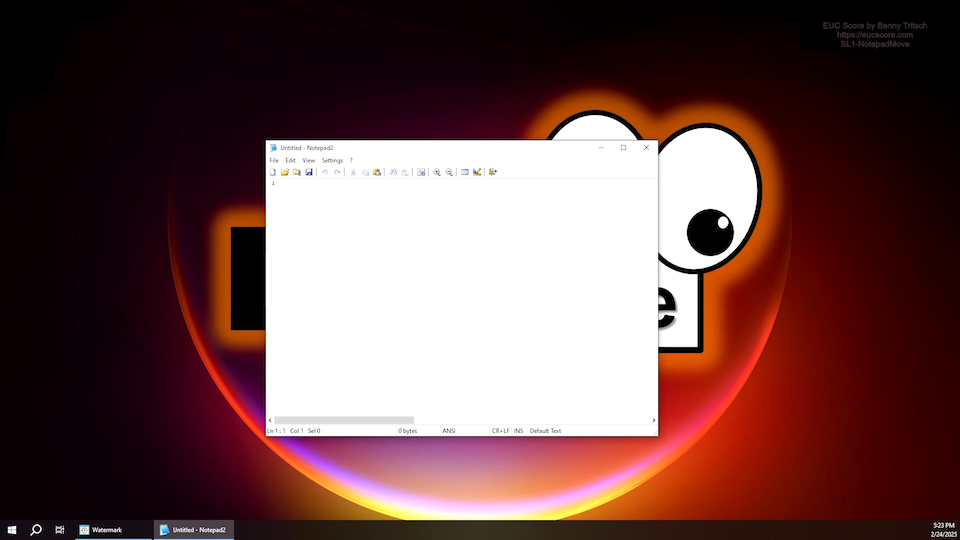
Packet Loss: 0.0% vs 2.0%
SL1-NotepadMove [STD12] Side-by-Side View |
Even with a workload requiring little network bandwidth, the RDP protocol shows significant effects at a 2% packet loss rate (red). Moving an application window across the screen results in noticeable stuttering and freeze frames. |
Summary of Test Observations
The RDP session on a Windows 365 VM with 8 vCPUs delivers a very good perceived user experience under unrestricted network conditions. This largely holds true even for network connections with higher latency. The situation differs, however, with reduced bandwidth and, in particular, with a high packet loss rate; in these cases, clearly noticeable compression artifacts or stuttering may occur.
Test Setup Details
Windows 365 Baseline (Unconstrained)
Windows 365 with Network Limits
System Under Test: Azure Germany West Central, Windows 365 Enterprise, Intel Xeon Platinum 8370C 8vCPUs @ 2.80GHz, 32GB RAM, 128GB HDD (SAS), 1920x1080 Screen Resolution @ 30Hz, Single Monitor Setup, Remote Desktop Services SxS Network Stack.
System Under Test: Azure Germany West Central, Windows 365 Enterprise, Intel Xeon Platinum 8370C 8vCPUs @ 2.80GHz, 32GB RAM, 128GB HDD (SAS), 1920x1080 Screen Resolution @ 30Hz, Single Monitor Setup, Remote Desktop Services SxS Network Stack.
Connection: SxS RDP-UDP, 100mbps bandwidth, 10ms latency, 0% packet loss.
Connection: SxS RDP-UDP. Either 8mbps bandwidth limit or additional 100ms latency or 2% packet loss.
Endpoint: ASUS NUC 15 PRO, Windows 11, Intel Core Ultra 7 255H 16Cores @ 2.0GHz, 32GB RAM, Samsung SSD 990 EVO Plus 1TB, Intel Arc 140T GPU, 2GB VRAM, Windows App.
Endpoint: ASUS NUC 15 PRO, Windows 11, Intel Core Ultra 7 255H 16Cores @ 2.0GHz, 32GB RAM, Samsung SSD 990 EVO Plus 1TB, Intel Arc 140T GPU, 2GB VRAM, Windows App.